 Richard Gonzalez
Center Director, Research Center for Group Dynamics, Institute for Social Research
Co-Director, BioSocial Methods Collaborative
Amos N Tversky Collegiate Professor, Psychology and Statistics, LSA
Professor of Integrative Systems and Design, College of Engineering
| E-mail: | Email Richard Gonzalez |
| Address: | Research Center for Group Dynamics Institute for Social Research University of Michigan 426 Thompson Street Ann Arbor, Michigan 48106 |
| Phone: | 734-647-6785 |
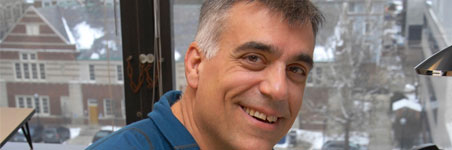
About Me
I received my PhD in 1990 from Stanford University in Psychology. I worked with Phoebe Ellsworth studying psychology and law and with Amos Tversky studying mathematical modeling and judgment and decision making. I spent seven years at the University of Washington’s Psychology department, a sabbatical year at Princeton University, and have been at the University of Michigan’s Psychology department since 1997. More about me >>

Research
My research interests focus on judgment and decision making (JDM). Given that so many topics in psychology are related to JDM it makes it look as though I work on many different topics. Actually, I see a simple theme across all my research. I am interested in how people make judgments and what influences their decisions and choices. More about Research >>

People
I’ve been fortunate to work with amazing colleagues, coauthors, collaborators, and students throughout my career. Read about People >>

Teaching
- Theories of Social Psychology
- General Linear Modeling Course
- Multivariate Statistics
- Generalized Linear Modeling Course
- Structural Equations Modeling Course
- Statistics Animation Page
- Design Science PhD Program
Recent Posts
Supportive relationships can attenuate the appeal of choice
We show how being reminded of particular types of social relationships reduces the appeal of large choice sets.
Teaching concept generation to engineers
We show how our heuristic techniques help engineering designers explore the concept space to achieve more novel solutions and explore the problem/solution space more effectively.
Does interacting with others make you more confident in your judgments?
We examine how individuals become more overconfident in their knowledge when interacting with other decision makers. In three studies we test several possible explanations. The most consistent explanation for our findings is one of “rationale construction” where confidence increases by virtue of having to explain or justify one’s choices to others.
How do we distort probability when making risky decisions?
We present preference conditions for the curvature of the probability weighting function in the context of cumulative prospect theory. Those conditions are tested with a new “ladder” procedure.