 Richard Gonzalez
Center Director, Research Center for Group Dynamics, Institute for Social Research
Co-Director, BioSocial Methods Collaborative
Amos N Tversky Collegiate Professor, Psychology and Statistics, LSA
Professor of Integrative Systems and Design, College of Engineering
| E-mail: | Email Richard Gonzalez |
| Address: | Research Center for Group Dynamics Institute for Social Research University of Michigan 426 Thompson Street Ann Arbor, Michigan 48106 |
| Phone: | 734-647-6785 |

About Me
I received my PhD in 1990 from Stanford University in Psychology. I worked with Phoebe Ellsworth studying psychology and law and with Amos Tversky studying mathematical modeling and judgment and decision making. I spent seven years at the University of Washington’s Psychology department, a sabbatical year at Princeton University, and have been at the University of Michigan’s Psychology department since 1997. More about me >>

Research
My research interests focus on judgment and decision making (JDM). Given that so many topics in psychology are related to JDM it makes it look as though I work on many different topics. Actually, I see a simple theme across all my research. I am interested in how people make judgments and what influences their decisions and choices. More about Research >>

People
I’ve been fortunate to work with amazing colleagues, coauthors, collaborators, and students throughout my career. Read about People >>

Teaching
- Theories of Social Psychology
- General Linear Modeling Course
- Multivariate Statistics
- Generalized Linear Modeling Course
- Structural Equations Modeling Course
- Statistics Animation Page
- Design Science PhD Program
Recent Posts
Understanding circumplex models: An application to vocational interest
In trying to understand an application of the circumplex structure to vocational structure, I struggled with geometric representation in theory development and data analysis. This short paper discusses some diagnostics one could apply to data to test the circumplex structure and provides some thoughts on the role of models in theory development.
Contextual cues influence judgment biases but only if they activate relevant motives
We show how judgment biases can vary as a function of contextual cues that are relevant to an individual.
Why sometimes we choose differently than how we advise
There several reasons why what’s good for the goose is not always seen as being good for the gander. The attributes of a decision may be weighted differently when choosing for oneself compared to when giving advise. We present a simple model and some data suggesting that advice tends to focus on one prominent attribute, but choice for oneself tries to deal with tradeoffs.
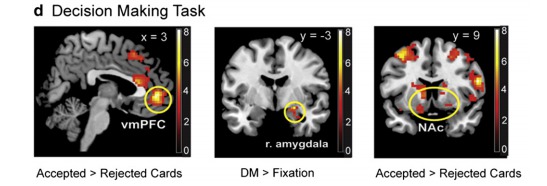
How do emotions help us learn and decide?
We developed a new paradigm where participants learn risky contingencies and then make decisions based on what they learned, all while in an MRI machine so BOLD can be measured along with the behavioral data. We find that affective processes play an important role in shaping subjective value in decision making as well as learning.